Apple says the iPhone Duo inner display uses a stiffer protective polymer. But stiffness, scratch resistance and real-world durability are different questions.
A fingernail presses against the inner screen of Apple's iPhone Duo. The surface appears unchanged. No obvious scratch, no dramatic damage, and a demonstration that seems to address one of the most persistent anxieties surrounding foldable phones.
It is an arresting clip. It is also not a durability test.
In the supplied video, commentator Sal reacts to that demonstration with a mix of excitement and caution. As a longtime Galaxy Z Fold user, he knows how easily a flexible display can become a costly problem. But he acknowledges that the clip reveals neither the force applied nor damage that might be invisible on camera.
That is the right starting point for assessing Apple's first foldable. The iPhone Duo may represent an important materials-engineering advance. What it has not yet established is that its inner display can withstand every kind of real-world abuse better than Samsung's.
This is a source-based analysis of Sal's commentary and Apple's published technical claims, not an independent Belliste scratch, drop or longevity test.
Sal's video opens with footage of a person pressing a fingernail against the iPhone Duo's folding screen. The surface appears to emerge unmarked.
For anyone familiar with flexible OLED displays, that is intriguing. Foldable inner screens have traditionally used protective polymer layers that feel softer than the rigid glass on conventional smartphones. They can be vulnerable to concentrated pressure from hard or pointed objects.
But a short clip cannot establish a scratch-resistance rating. We do not know the pressure, the condition of the fingernail, the lighting, whether the same area was examined afterward, or how the surface would respond to repeated contact.
There is also a difference between a visible surface mark and damage to the display stack beneath it. A screen might show no immediate scratch while still suffering internal stress; conversely, a cosmetic mark does not necessarily mean the panel itself has failed.
Sal explicitly recognizes these limitations. His reaction is interest, not proof. Belliste should not turn that uncertainty into a definitive claim that the Duo is 'scratch-proof.'
Apple's September 2026 announcement describes the inner protective layer as a custom nano-textured polymer with up to 40% higher stiffness than other materials used in the industry.
That wording matters. Stiffness describes resistance to deformation under load. Scratch resistance concerns how a surface responds to abrasive or pointed contact. Puncture resistance, fatigue from folding and resistance to impact are different properties again.
No. The fingernail demonstration is not a controlled scratch test.
No. Apple specifies up to 40% higher stiffness for its protective polymer, a different property.
Apple announced support for Apple Pencil (USB-C) later in 2026.
Apple claims reduced crease visibility, not a physically absent crease.
Not independently. Verify regional AppleCare+ terms and distinguish the protective layer from the full display.
A stiffer polymer might help distribute force or resist certain types of indentation, but the 40% figure alone does not prove a 40% improvement in scratch resistance. Apple does not provide a directly comparable independent fingernail or Mohs-hardness result in the announcement.
The video's description of the display as '40% tougher' compresses several engineering questions into one appealing phrase. Apple's actual claim is narrower.
Apple also describes high-strength glass layers above and below the folding display panel, adhesives that permit relative movement between layers, and a titanium support plate beneath the assembly. These elements address different stresses within the folding mechanism.
The design sounds sophisticated. Durability will ultimately depend on how the complete structure behaves after thousands of folds, pressure events, dust exposure and ordinary wear—not on a single material property.
A conventional smartphone display is protected by a rigid glass surface. A foldable screen must bend repeatedly around a hinge without cracking or delaminating.
Manufacturers therefore balance flexibility, surface hardness, optical clarity, crease management and structural support. Improving one property can create compromises elsewhere.
Sal recalls a painful example from his own ownership history: his daughter accidentally punctured the inner display of his Galaxy Z Fold 3 with an S Pen from a Galaxy S22 Ultra. A black spot appeared and later spread across the screen.
That anecdote is meaningful because it illustrates the consequences of localized damage. It does not establish a failure rate for Galaxy Z Fold devices. Sal also says he used foldables for years without scratching their inner displays during normal use.
Both parts of his account belong in a fair article. Foldables can be fragile under unusual pressure while remaining perfectly serviceable for careful owners.
Apple's challenge is to reduce that vulnerability without making the screen feel unpleasant, look washed out or develop problems as the hinge ages.
Apple says the iPhone Duo will support Apple Pencil (USB-C) later in 2026, allowing writing and annotation on its displays.
That is a notable design decision. A stylus applies repeated, localized contact, and Apple is evidently confident enough in the display's construction to introduce an official Pencil experience.
But the source video goes further than Apple's announcement when it suggests the exact same Pencil designed for the iPad Pro. Apple's published wording specifically names Apple Pencil (USB-C). Compatibility should be described using Apple's official accessory name, not generalized to every Apple Pencil model.
Samsung previously engineered special foldable-compatible S Pen tips to reduce stress on flexible screens. Sal contrasts that caution with Apple's approach and notes changes in Samsung's stylus strategy across generations.
The comparison is interesting, but accessory support is not a substitute for independent durability testing. Apple Pencil compatibility tells us which interactions Apple intends to support. It does not mean arbitrary sharp objects are safe.
Until the promised software support arrives and real-world testing is available, prospective buyers should treat stylus capability as an announced feature rather than a fully assessed ownership advantage.
The same commentator challenges claims that the iPhone Duo is entirely crease-free. In a second clip, he sees a visible fold line and considers it broadly comparable to the Galaxy Z Fold 8 under those viewing conditions.
Apple's official language is more restrained: the nano-texture finish is designed to minimize crease visibility and reduce reflections. That is not the same as saying the crease is physically absent.
A matte surface diffuses reflections. Under some lighting, that can make the fold less conspicuous than on a glossy panel. But surface texture can also affect the perceived punch of colors, clarity and contrast.
Sal prefers Samsung's approach to anti-reflection and display vibrancy. That is a legitimate personal preference, not a controlled optical measurement proving that the Duo has inferior contrast.
The relevant questions are how the screen looks in direct sunlight, how text appears on the nano-texture finish, and whether the crease becomes more visible with use. These require side-by-side evaluation under consistent conditions.
A crease that is harder to see is a meaningful improvement. It is not evidence that the underlying fold has been eliminated.
Sal highlights a potentially important repair detail: reports that the iPhone Duo's inner protective layer can be replaced, with a quoted $19 charge under AppleCare+.
That number should not be treated as a universally confirmed repair price without a matching official service schedule specifying the country, coverage and type of damage. A protective-layer replacement is also not necessarily the same service as replacing a damaged OLED panel.
This distinction can determine the real cost of ownership. A scratched removable layer may be inexpensive to address, while internal panel damage can involve a much larger repair.
Apple's public product announcement explains the layered display structure but does not, by itself, verify every repair scenario or the $19 figure mentioned in the video.
Before pre-ordering, buyers should check the local AppleCare+ terms, deductible categories, accidental-damage exclusions and out-of-warranty service pricing. Those conditions may differ by region.
A foldable's repair policy can be as important as its advertised durability. Even a tougher screen is not invulnerable.
The video also cites a report suggesting iPhone Duo manufacturing yields just above 60%. The commentator interprets that as roughly four in ten attempted units failing to meet the relevant standard.
That is a plausible reading of the term 'yield,' but it depends on what the underlying report actually measured. It could refer to a particular component, stage of assembly or production period rather than the percentage of finished phones rejected at the end of the line.
The supplied transcript does not identify the report or provide a methodology that would let Belliste independently verify the figure. It should therefore remain an unverified reported estimate, not a confirmed Apple production statistic.
Low early yields can constrain supply and raise costs, but they do not automatically prove a launch delay. Manufacturers can improve yields over time, adjust production and build inventory ahead of release.
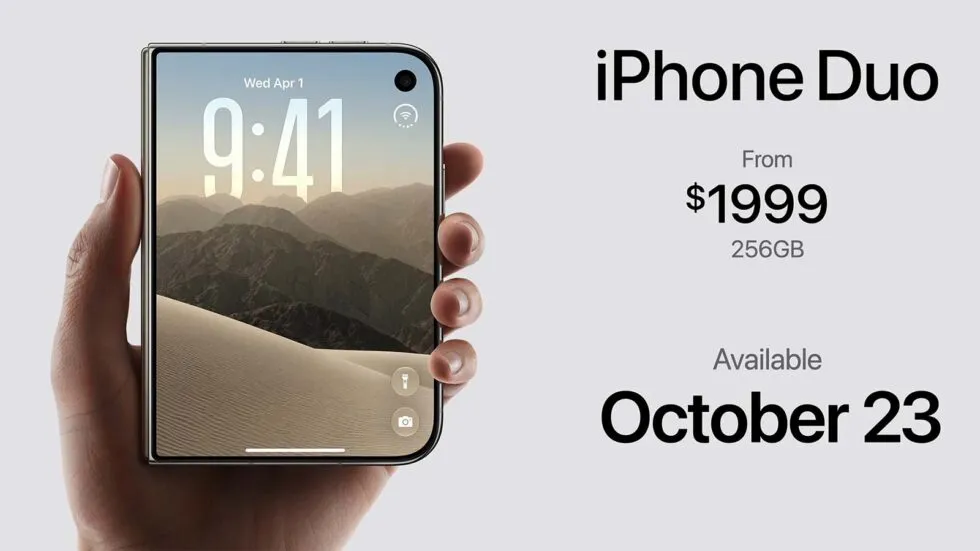
Apple has announced October 16, 2026 pre-orders and October 23 availability. As of October 13, those dates are still ahead. The production rumor should be weighed against the official schedule rather than presented as evidence that a delay has occurred.
For shoppers, the practical risk is availability: a popular first-generation foldable could be hard to obtain in some configurations even if it launches on time.
The video's comparisons with the Galaxy Z Fold 8 are useful because Samsung has spent years refining foldable hinges, protective layers and display surfaces.
But declaring a winner on durability today would be premature. A demonstration of fingernail pressure on one device cannot substitute for equivalent testing on both devices. The same is true of judging creases from separate clips filmed under different lighting.
Apple's published design includes a titanium frame, an elaborate hinge and a custom protective display stack. Samsung brings experience from multiple foldable generations. Neither advantage alone settles which screen will survive accidental pressure or years of folding better.
A serious comparison would test controlled indentation, surface abrasion, crease changes, folding cycles, particle intrusion and repairability under matched conditions.
It should also distinguish cosmetic damage from functional failure. Those are different outcomes with different consequences for users.
The iPhone Duo may change the competitive conversation. Whether it changes the durability benchmark remains an open question.
At approximately $1,999 in US launch pricing, the iPhone Duo asks buyers to take a first-generation risk at a premium price.
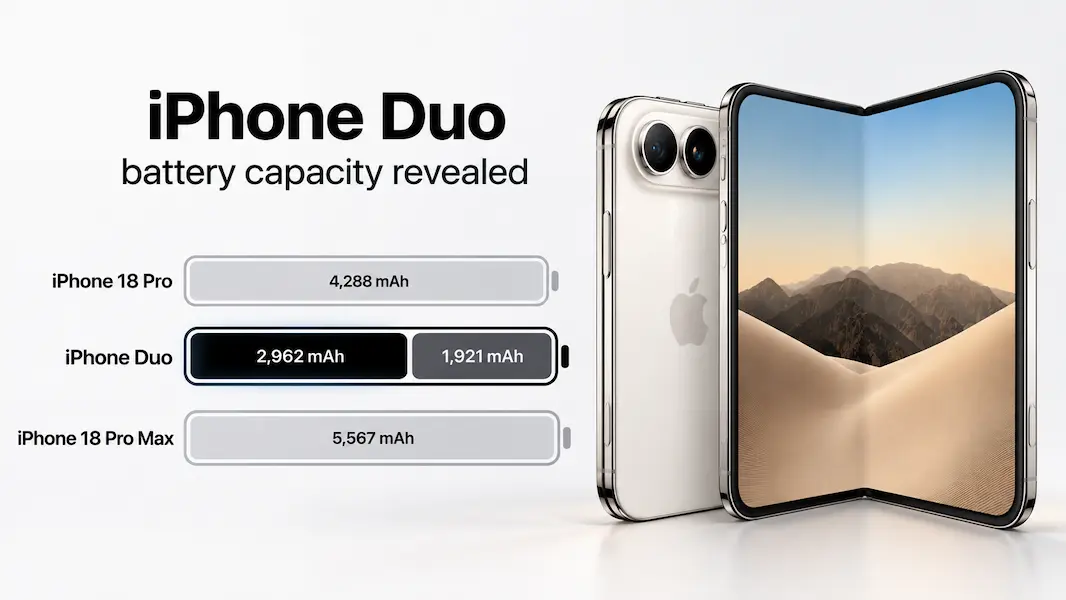
Apple has announced a 7.6-inch inner display, 5.4-inch cover screen, A20 Pro, and a nano-textured folding surface. Those specifications establish what the device is designed to offer. They do not tell us how the inner display will look after a year of pocket lint, fingerprints, pressure and repeated folding.
The video makes the strongest case for waiting to see what independent tests reveal. Its most compelling moment is not the apparent absence of a fingernail scratch. It is the creator's admission that the clip cannot prove enough.
Consider the iPhone Duo if you want Apple's foldable software experience and accept the uncertainties of an expensive first-generation product.
Wait for independent durability and repair testing if screen fragility is your primary concern.
Compare Samsung's foldables if you value an established product line, while remembering that long market experience is not proof of invulnerability.
Apple may have made an important improvement to the foldable screen. The honest conclusion, for now, is that it has published an intriguing engineering claim—not a verdict on real-world durability.
Sources and methodology: This analysis uses [Sal's iPhone Duo durability commentary](https://www.youtube.com/watch?v=wCzaBW2Aqn0), [Apple's September 2026 iPhone Duo announcement](https://www.apple.com/newsroom/2026/09/apple-unveils-iphone-duo/), and [MacRumors' breakdown of the display layers](https://www.macrumors.com/2026/09/09/iphone-duo-folding-screen-layers/). Belliste did not perform hands-on or laboratory testing.