An editorial Pixel 10 Pro review covering Tensor G5, Pixelsnap magnetic charging, cameras, battery life and value versus Pixel 10 and Pixel 9 Pro.
The Google Pixel 10 Pro is a compact flagship built around refinement rather than reinvention. It keeps the Pixel 9 Pro's recognizable design and much of its camera hardware, but adds the Tensor G5, magnetic Pixelsnap charging, a slightly larger battery and a brighter screen. Whether those changes justify the price depends less on the spec sheet than on which phone you already own.
This Belliste review evaluates the supplied article's claims and published product specifications; it is not an independent hands-on test. The accompanying YouTube review is provided above, but its spoken claims have not been independently transcribed or verified here. The $999 figure below is the US launch price, not a confirmed current offer.
Google's most consequential hardware change is the Tensor G5, manufactured using a 3nm-class process. It replaces the previous Tensor generation and underpins newer on-device AI features. The Pixel 10 Pro also introduces Pixelsnap, Google's magnet-aligned Qi2 charging system.
Battery capacity rises from 4,700mAh on the Pixel 9 Pro to 4,870mAh, while Google's advertised peak display brightness climbs from 3,000 to 3,300 nits. The new Pro Res Zoom feature extends digitally assisted zoom to 100x.
The rear camera resolutions and lens arrangement are familiar. Buyers hoping for a new optical zoom system or a radically different compact design will not find one here.
| Feature | Google Pixel 10 Pro |
|---|---|
| Display | 6.3-inch Super Actua LTPO OLED, 1280 × 2856, 1–120Hz |
| Brightness | Up to 2,200 nits HDR; 3,300 nits peak, manufacturer ratings |
| Processor | Google Tensor G5; Titan M2 security chip |
| RAM | 16GB |
| Storage | 128GB, 256GB, 512GB or 1TB |
| Rear cameras | 50MP main; 48MP ultrawide with macro; 48MP 5x telephoto |
| Selfie camera | 42MP |
| Zoom | Up to 100x Pro Res Zoom, computational |
| Battery | 4,870mAh typical |
| Charging | Up to 30W wired; 15W Pixelsnap Qi2 wireless |
| Software support | Seven years of OS, security and Pixel Drop updates |
| Launch price | From $999 in the US |
Storage options and promotional bundles vary by market. The Pixel 10 Pro should not be confused with the larger Pixel 10 Pro XL, which has different size and charging characteristics.
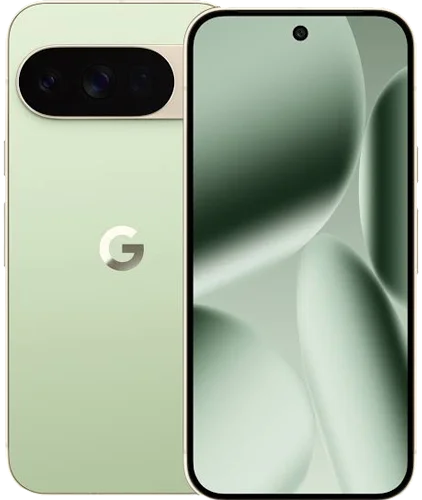
The Pixel 10 Pro retains the Pixel 9 Pro's frosted-glass appearance and prominent camera bar. It is slightly heavier and thicker, but the 6.3-inch size still appeals to people who want flagship cameras without a large handset. Compact does not necessarily mean effortless one-handed use, especially near the top of the screen.
The LTPO OLED adapts from 1Hz to 120Hz, helping static content use less power while keeping scrolling fluid. Google's quoted 3,300-nit peak brightness is higher than the 9 Pro's rating, although peak values are not the same as sustained full-screen outdoor brightness.
The most meaningful design question for long-term ownership may be repairability. Replacement parts and service access matter when a manufacturer promises seven years of updates; a support policy cannot prevent physical wear or battery aging.
The Tensor G5 is Google's first Tensor generation produced by TSMC, marking a manufacturing change as well as an architectural one. Google has promoted substantial CPU and machine-learning gains over Tensor G4. Those percentages are manufacturer comparisons, not Belliste benchmark results.
Published reviews generally describe smooth daily performance. Messaging, maps, photography and multitasking are unlikely to expose the chip's weaknesses as clearly as demanding 3D games. Graphics-heavy gaming remains a reason to compare competing flagship processors, particularly if high frame rates and sustained performance are priorities.
The 16GB RAM allocation also separates the Pro from the regular Pixel 10. It provides room for demanding apps and on-device AI tasks, although memory capacity alone does not guarantee faster performance.
Features such as Magic Cue and newer Gemini Nano capabilities are part of Google's software argument for Tensor G5. Their usefulness depends on language, region, permissions and supported apps. Buying for a particular AI feature is sensible only after confirming that feature is available where you live.
Pixelsnap adds magnetic alignment for compatible Qi2 chargers, stands and car mounts. That is more convenient than manually centering a phone on a flat wireless pad, particularly on a desk or in a vehicle.
On the Pixel 10 Pro, wireless charging tops out at 15W with compatible equipment. The Pixel 9 Pro could reach a higher proprietary wireless rate with Google's dedicated stand, so the new system prioritizes accessory compatibility and alignment over maximum charging speed. Do not assume every MagSafe accessory will deliver the advertised Qi2 charging rate.
The rear system combines a 50MP main camera, a 48MP ultrawide with macro focus and a 48MP telephoto with 5x optical zoom. The 42MP front camera remains a standout specification for a compact flagship.
The hardware arrangement closely resembles the Pixel 9 Pro's. Google's processing, stabilization and new computational modes therefore carry much of the upgrade story. Published reviewers praise Pixel still photography, but this article does not claim to have shot or compared original camera samples.
Pro Res Zoom reaches 100x, far beyond the lens's optical magnification. At extreme ranges, AI-assisted reconstruction can produce plausible-looking detail that is not necessarily a faithful record of distant text, patterns or small objects. For documentary accuracy, treat the 5x optical range—and carefully judged moderate zoom—as more dependable than a dramatic 100x example.
Video options include 10-bit HDR and 8K Video Boost, with processing and service requirements that differ from straightforward local recording. Camera Coach can suggest framing ideas, but it cannot replace a good sensor, stable hands or suitable lighting.
The regular Pixel 10 now has a telephoto camera too. That narrows the gap for casual zoom photos. The Pro still offers more capable imaging hardware overall, including its higher-resolution ultrawide, macro capability and longer optical reach.
The 4,870mAh battery is modestly larger than the Pixel 9 Pro's 4,700mAh cell. Google advertises more than 24 hours of use and up to 100 hours in Extreme Battery Saver. These are manufacturer estimates under defined usage assumptions, not independent Belliste endurance measurements.
Wired charging is rated at up to 30W, with Google advertising roughly 55% in about 30 minutes under compatible conditions. Real charging depends on the adapter, cable, temperature and starting charge level. Battery capacity alone does not establish that the Pixel 10 Pro will outperform every rival or every Pixel 9 Pro in mixed real-world use.
Google promises seven years of OS, security and Pixel Drop updates from the device's initial availability. That extends the useful software life of a phone that owners may want to keep for several years. It is not a guarantee that its battery will retain capacity or that every future feature will work on this hardware.
Some launch promotions included access to Google AI Pro for a limited period. Promotional eligibility and duration can change, so do not count a subscription as a permanent part of the phone's value.
Against the Pixel 10: the regular model shares the Tensor G5 generation and magnetic charging, and it has its own telephoto camera. The Pro offers 16GB RAM, more storage choices, a sharper display and a stronger overall camera system. At their respective US launch prices—$799 and $999—the question is whether those improvements justify $200. At current retail prices, compare the actual difference instead.
Against the Pixel 9 Pro: the newer model adds Tensor G5, Pixelsnap, a modest battery increase, higher advertised peak brightness and expanded zoom processing. If you already own a working 9 Pro, those gains alone rarely justify replacing it. A discounted 9 Pro can also be attractive if magnetic accessories and the latest AI functions are unimportant to you.
Against newer Pixels: compare current prices, remaining software support and the specific features you would use. Do not assume a previous-generation Pro is a bargain merely because its original price was higher.
Buy it if you want a relatively compact Android flagship with versatile cameras, long software support and magnetic charging—and the current price is competitive.
Skip it if you already own a Pixel 9 Pro, prioritize demanding mobile gaming, or would be satisfied by the less expensive Pixel 10's camera system.
Look closely at storage: the 128GB base configuration can feel restrictive for frequent 4K video, offline media and large games. Since there is no microSD expansion, choose capacity for your actual usage rather than the headline starting price.
The Pixel 10 Pro remains appealing because it combines a manageable size with a serious camera system, 16GB RAM, Google's software features and seven years of updates. Tensor G5 and Pixelsnap make it more convenient and capable than its predecessor in specific ways.
But the rear camera hardware is familiar, the battery increase is small and wireless charging is not universally faster than before. The 100x zoom headline is also less useful for accurate everyday photography than the optical lenses underneath it.
At $999 launch pricing, the Pixel 10 Pro required a clear preference for the Pro's cameras, display and memory over the base Pixel 10. In 2026, the answer depends on real retailer pricing. Choose it for its compact flagship package at the right price, not because it is a major leap from the Pixel 9 Pro.
The Pixel 10 Pro launched in the US at $999 for 128GB. Current prices depend on storage, market and retailer; compare live offers before buying.
It remains a strong compact Android flagship for photography, software support and magnetic charging. Its value depends on the current price relative to the Pixel 10, Pixel 9 Pro and newer alternatives.
It uses Google's Tensor G5 processor with 16GB of RAM. The chip emphasizes Google's AI and imaging features, while demanding gaming performance is not its strongest selling point.
Yes. The Pixel 10 Pro supports magnetic Qi2 charging through Pixelsnap at up to 15W with compatible accessories.
For most Pixel 9 Pro owners, the Tensor G5, Pixelsnap, slightly larger battery and higher peak display brightness are not enough on their own to justify replacing a working phone.