Meta has released Muse Spark Open. We examine its memory requirements, the two-Mac demonstration, license conditions and what developers should test before adopting it.
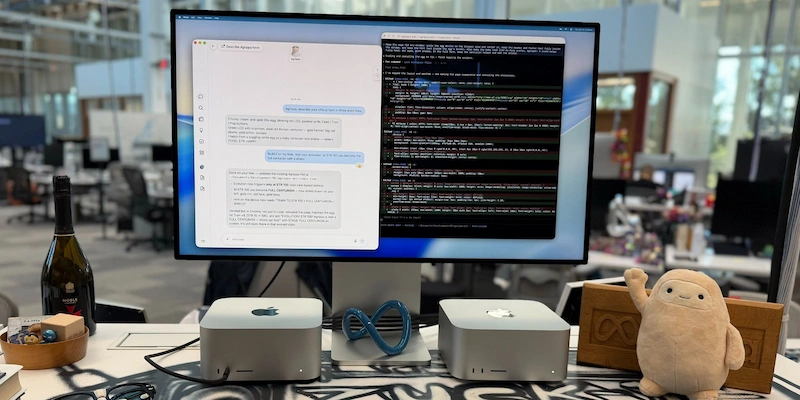
Two compact desktop computers beneath a monitor displaying chat and code. Image supplied for this article.
Meta released Muse Spark Open on October 15, 2026, making the weights of its large agentic model available to developers. Meta describes it as its strongest US open-weight release. That is the company's positioning, not a verdict from a Belliste hands-on test. Meta's announcement
The interesting question is what "open" makes possible in practice. Downloadable weights give teams more control over deployment. They do not make the equipment, engineering or operating costs disappear.
The official model card describes a mixture-of-experts model with 816 billion parameters, roughly 42 billion active per token and a context window of about one million tokens. It accepts text, images, audio and video, and generates text.
The distinction between total and active parameters matters. Using a subset of experts reduces the work required for each token; it does not mean the remaining weights vanish from the deployment. A model can be comparatively economical to compute with while remaining expensive to hold in memory.
For readers familiar with the Meta AI assistant, this is a separate deployment question: access to an assistant through an app is different from obtaining model weights and operating the model yourself.
Meta demonstrated the model on two M5 Ultra Mac Studios with 1TB of combined unified memory, using Apple's MLX framework. That is a reported configuration—not evidence that every possible deployment requires exactly that much RAM or must use a Mac. Meta's Apple Silicon description
The deployment documentation lists different checkpoints:
| Checkpoint | Approximate weight size | What the number means |
|---|---|---|
| BF16 | 1.65TB | Weight storage alone, before runtime memory |

| NVFP4 | 537GB | Compressed weights, with some layers retained in BF16 |
Weights are only part of the budget. Context caches, activations and the inference runtime also consume memory. Meta's BF16 guidance budgets roughly 2TB of GPU memory. The compressed checkpoint has a smaller footprint, but its download size is not a complete running-memory requirement.
These figures explain why "it runs locally" needs qualification. For an ordinary laptop owner, the practical distinction is between trying a hosted service and buying infrastructure—not between downloading an app and launching it.
The nationality of a model supplier can matter to procurement teams. Some organizations have internal restrictions, hosting requirements or preferences about their technology partners. Those decisions vary by organization; a model's country of origin alone does not establish its security or suitability.
Belliste's interpretation: Meta's positioning may appeal to teams seeking another US-developed option. That is a potential purchasing argument, not proof that the model outperforms alternatives from Chinese or other laboratories.
Any comparison with Qwen, Kimi or GLM should identify the exact versions, settings and tasks. "Best" is not a useful purchasing criterion until someone defines the job and measures both the result and the cost of getting it.
Meta reports using Muse Code for changes to Ice Cubes, an open-source Mastodon client, and for a DaVinci Resolve workflow involving footage selection and vertical crops. These are examples chosen by the company. Launch demonstrations
A convincing demonstration shows that a workflow is possible under its particular conditions. It does not tell a team how often it will succeed on unfamiliar repositories, what permissions it needs, or how much human correction it will require.
This article reviews launch documentation as of October 17, 2026. Belliste has not run the model locally or independently reproduced its performance claims. Before committing hardware, test a representative task, log failures and measure correction effort alongside speed.
Muse Spark Open uses the Muse Model License, rather than an unrestricted promise of commercial use. The published terms include attribution requirements, a usage policy and additional conditions for certain model-as-a-service businesses. Read the actual license against your intended deployment before building a product around it.
Open-weight and open-source are not interchangeable labels. For a team choosing a model, the practical questions are what it can download, modify, redistribute and offer to customers under the applicable terms.
Meta lists hosted access through providers including Fireworks AI, Together AI and OpenRouter. That offers a way to evaluate the model without first purchasing the desktop setup. Availability details
Apple gets a useful showcase for local AI hardware. Meta gets a route to developers who want deployment control. Whether either company benefits most will depend on adoption, operating costs and real-world reliability; the launch alone cannot settle it.
The release is worth evaluating because it expands the choices available to builders. The sensible next step is a small, measurable trial. Open weights are a starting point for that evaluation—not a shortcut past the hardware bill.
No universal 1TB minimum is established by Meta's desktop demonstration. Requirements depend on the checkpoint, inference engine, context length and other runtime memory. The two-Mac demonstration should not be treated as the specification for every deployment.
Yes. Meta lists hosted API providers and inference support beyond Apple hardware. Check your chosen provider's availability and terms, or the official deployment guidance for self-hosting.
No. This article covers a downloadable model release. Meta AI is an assistant experience; using an assistant and operating model weights yourself are different ways of accessing AI.
This article does not establish that. A useful comparison needs named model versions, comparable test conditions and results on the tasks you intend to run.
No. The Muse Model License and usage policy apply. Check the published terms for attribution, redistribution and conditions relevant to your business.

Free multimodal AI assistant across Meta apps, web, mobile and glasses.
Free $0/month · Meta One Core from $7.99/month
Visual automation platform with AI Agents, 3,000+ apps, APIs, webhooks, and credit-based execution.
Free $0/month · Core from $12/month
No-code AI agent and workflow automation platform with 300+ connectors, subagents, human approvals, company knowledge, skills and multi-model routing.
Free $0/month · Pro from $37/month
No-code AI agents that can use business knowledge, browse the web, and take action across Zapier's 9,000+ app ecosystem.
Free $0/month · Pro from $33.33/month
AI-native workflow automation platform combining visual workflows, code, self-hosting, and autonomous AI agents.
Free €0/month (self-hosted) · Starter from €20/month
No-code AI agent platform for building autonomous agents, AI-native workflows, web apps, browser extensions and API/MCP services across 200+ AI models.
Free $0/month + usage · Individual from $20/month + usage
AI teammate and agent platform for automating work across apps, meetings, inboxes, research, and scheduled routines.
Free trial $0 · Plus from $29.99/user/month
Low-code enterprise agent platform for building autonomous AI agents, workflows and multi-agent business processes across Microsoft and external systems.
Pay-as-you-go $0.01/Copilot Credit · Pack $200/month
Apple’s foldable iPhone is available to pre-order in launch markets. Here are the US starting price, rollout dates and camera details to check before ordering.

Apple has unveiled the iPhone Duo, its first foldable iPhone. Here are the confirmed display, chip, camera, price and release details ahead of October availability.