Perplexity for web discovery, ChatGPT for a longer research project? Belliste compares the workflows, source checks and costs that should decide your subscription.
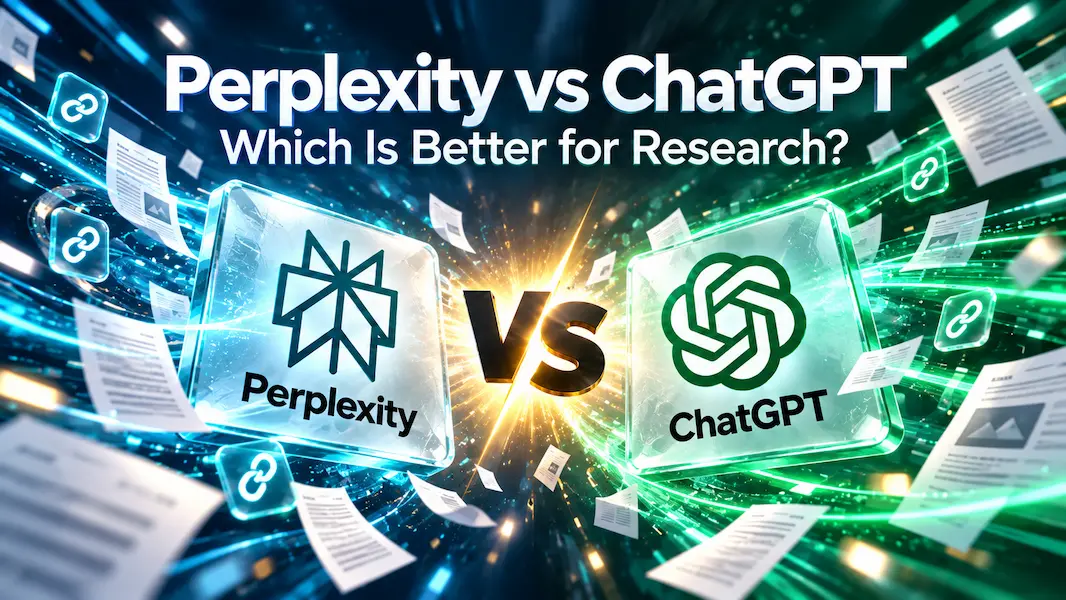
Belliste's call: choose Perplexity when the main job is finding your way through the web. Choose ChatGPT when the research is part of a longer project involving analysis, revision and a finished document.
There is enough overlap that either can handle much of the other tool's territory. We would still make the purchase around the work you repeat most often. Someone checking developments across several unfamiliar subjects has a different need from someone combining interviews, spreadsheets and published evidence into a report.
Our sharper view in the Perplexity vs ChatGPT debate is this: a long answer covered in citations has not earned your trust until those citations survive inspection. The better research tool is the one that leaves you with less verification and correction work.
This is a research-based comparison. Belliste has not run a controlled benchmark of the two products, and our recommendations should not be read as measured accuracy or speed rankings.
First, decide what you mean by research
Finding an announcement, explaining a subject, assessing conflicting evidence and analyzing your own dataset are different tasks.
For a quick question, a search answer may be sufficient. For a decision involving several sources, you need to examine what each source establishes. For a quantitative report, you also need to inspect the calculations and assumptions.
The work in front of you
Belliste's starting choice
What to inspect
Get oriented on a current web topic
Perplexity
Original sources, dates and missing context
Explore related questions and possible angles
Perplexity
Whether follow-ups improve the inquiry
Combine web evidence with your own data
ChatGPT
Input quality, calculations and source boundaries
Develop a report through repeated revisions
ChatGPT
Whether citations and caveats survive editing
Produce a deeper sourced investigation
Evaluate both research modes
Coverage, contradictions and unsupported conclusions
Verify a claim before publication
Open the underlying evidence
Neither product's summary is sufficient
These are workflow recommendations. They do not establish that one product retrieves a better source on every query.
Why we would start web research in Perplexity
Perplexity is built around cited answers from web search. Its free core search provides a practical way to investigate a topic before committing to a subscription.
That orientation suits a common research problem: you know the question, but you do not yet know which organizations, documents or terminology matter.
A useful opening request could be: identify the original announcement, explain what changed and list the questions the announcement leaves unanswered. The output gives you a route into the evidence.
Zapier's comparison favors Perplexity's search experience, including source presentation and follow-up exploration. Tom's Guide also preferred Perplexity in a March 2026 comparison using three research prompts.
Those are attributed judgments from their respective authors. Tom's Guide's small set of prompts is useful context, but it cannot establish a universal winner across scientific literature, company research and document analysis.
Our judgment: Perplexity is a sensible first stop for frequent web investigation. We would use it to discover and organize the material, then inspect the sources that carry the conclusion.
Why we would choose ChatGPT for a longer project
ChatGPT combines web research with file analysis and an iterative writing environment. Its documented data-analysis capabilities include working with uploaded spreadsheets, producing tables and charts, and running Python-based calculations.
That combination matters when the question cannot be answered from published pages alone.
Imagine preparing a report about customer demand. Your spreadsheet contains the actual enquiries; external research provides market context. The useful task is to keep those evidence types separate, analyze the internal data and explain how far the comparison can reasonably go.
We would start that project in ChatGPT. You can ask it to inspect the dataset, show the method and revise the report as the question becomes clearer.
This is not an exclusive capability claim. Perplexity also supports file analysis, and its current product offering extends into creating reports, spreadsheets and other deliverables.
Our judgment: ChatGPT is our preferred starting workspace when research leads into repeated analytical and editorial work. The recommendation rests on that combined workflow, rather than a claim that its first web answer is always better.
Both now offer more than a short search answer
ChatGPT's deep research can use the public web, uploaded files and eligible connected apps. OpenAI documents a proposed plan you can review, controls for selected websites, progress updates and a report with citations. Availability depends on the account and workspace.
Perplexity documents a Research mode for complex questions and a Deep Research experience inside Computer. Its product material describes combining web sources with files and turning findings into deliverables. Check which experience and allowance your plan actually includes.
An older comparison that treats ChatGPT research as limited to public webpages misses its currently documented file and app support. Likewise, treating Perplexity as only a compact answer engine misses its broader current tools.
The decision is consequently more demanding than “search versus chatbot.” Compare the modes you intend to use.
For an immediate fact, use a quick search. For a question requiring several lines of investigation, consider a research mode. Spending more time generating a longer report is worthwhile only when the extra work improves coverage and checking.
Citations are the start of verification
A citation can point to a real page and still fail to support the sentence beside it.
The page may discuss a related subject, quote another publication or describe an earlier version of a product. A statistic may concern a different country, sample or period.
When checking a consequential claim, we would inspect four things:
Support: does the source actually establish the specific statement?
Origin: is it the original document, or another summary?
Date: when did the event occur, and when was the page updated?
Scope: do the conditions and limitations match the answer?
For example, a vendor saying that a feature is being rolled out does not establish that every account has it. A report about survey respondents does not automatically describe the entire population.
This is where we refuse to award an automatic win to Perplexity for citation density or to ChatGPT for a persuasive explanation. Evidence quality decides the claim.
For an article, keep the source attached to the relevant fact throughout editing. A paragraph can become more confident with each revision while the evidence remains unchanged.
Fresh information needs more than a recent-looking answer
Both products can search the web. Make that requirement explicit when the question depends on current facts, and inspect whether the response actually includes fresh evidence.
Ask for the date of the underlying event separately from the publication date. A newly updated roundup can contain older product descriptions. Several recent articles can repeat the same announcement.
For a software comparison, start with current documentation and pricing. For an event, find the original announcement and reputable reporting that adds verification or context.
If sources disagree, ask the tool to preserve the disagreement and explain what would resolve it. An answer that quietly selects one version may be easier to read but less useful.
Our recommendation: choose Perplexity first for quick web orientation, but give neither service permission to turn an unresolved discrepancy into a settled fact.
Documents and data change the buying decision
Before uploading files, decide what question the material can answer.
A spreadsheet of enquiries can describe the enquiries recorded there. It cannot establish market-wide demand without additional evidence. A polished chart does not repair that gap.
ChatGPT's analysis tools can expose calculation code and outputs for review. Ask for the denominator, treatment of missing rows and any exclusions. For important figures, check the calculation against the source data.
Perplexity's Pro documentation also describes file analysis and tools for creating files and apps. If your work primarily combines documents with web findings, it deserves a trial on those actual inputs.
For either product, verify extraction before trusting analysis. A complex PDF or image-based table can lose context or values. Where possible, use a clean spreadsheet or text-based source.
We would favor the service that makes errors visible and corrections straightforward, even if its initial presentation looks less finished.
What should you pay?
Prices checked on October 27, 2026: Perplexity Pro is listed at $20 per month or $200 per year. ChatGPT Plus is listed at $20 per month. Applicable taxes and local checkout prices can differ.
Both provide free access, with restrictions on advanced features. Perplexity distinguishes basic search from its higher-tier searches and Research allowance. ChatGPT's deep-research allowance varies by plan, and its product counter shows remaining tasks.
Do not buy either subscription on the assumption that a monthly fee means unlimited advanced research. Product limits and their reset periods matter more than an old screenshot of a pricing table.
Our recommendation is conservative: begin with the free service or the subscription you already have. Pay for the second only after identifying a recurring limitation it resolves.
If ChatGPT already handles your reports and occasional searches, a Perplexity subscription needs a reason beyond curiosity. If web research dominates your day and Perplexity delivers the material you need, ChatGPT's broader feature list may add little value.
A fair way to compare them on your work
Use three representative questions: one current lookup, one topic with conflicting evidence and one task involving your own documents.
Keep the requirements comparable. Ask for primary sources where available, dates, uncertainties and a clear distinction between evidence and inference. Record which mode and plan you used.
Then inspect the important claims yourself. Count unsupported statements, missing sources and corrections. Include the time spent opening links and repairing the final output.
Do not compare a quick answer from one service with a deep-research report from the other and call the result a product benchmark. You may still prefer one workflow, but explain what you compared.
A tool wins your subscription when it repeatedly improves the work you need to finish.
Belliste's verdict
Perplexity gets our recommendation for frequent web discovery and quick topic orientation. ChatGPT gets our recommendation when research sits inside a broader analysis and writing project.
For a substantial investigation, we would trial both research experiences on a real brief. Their capabilities overlap too much to claim that one owns research and the other merely writes.
The non-negotiable standard is source inspection. We would rather publish a shorter conclusion with solid support than an impressive report whose central claim collapses when someone opens the link.
Editorial basis: Tom's Guide and Zapier informed this comparison; current vendor documentation was checked on October 27, 2026. Belliste's verdict is a workflow judgment, not a first-hand benchmark.
Frequently Asked Questions
Is Perplexity or ChatGPT better for research?
Belliste recommends Perplexity as a starting point for frequent web discovery and ChatGPT for research that continues into data analysis, drafting and revision. For deeper investigations, compare their research modes on a representative task.
Does ChatGPT search the web and provide citations?
Yes. ChatGPT supports web search, and deep research produces reports with citations or source links. Ask explicitly for current web research and inspect the underlying evidence.
Can ChatGPT deep research use uploaded files and connected apps?
Yes. OpenAI documents support for uploaded files, selected websites and eligible connected apps. Access depends on the plan, region, workspace configuration and provider permissions.
Can Perplexity analyze files and create reports?
Yes. Perplexity documents file analysis, Research mode and tools for creating files and apps. Its Deep Research experience in Computer also describes research-to-deliverable workflows. Check your plan's exact access.
Are Perplexity citations always proof that an answer is correct?
No. A citation is a route to evidence. Open it to check whether it supports the precise claim, uses the relevant date and applies to the correct context.
How much do Perplexity Pro and ChatGPT Plus cost?
As checked on October 27, 2026, Perplexity Pro is listed at $20 per month or $200 per year, and ChatGPT Plus at $20 per month. Taxes and local checkout prices can differ.
Should I pay for both Perplexity and ChatGPT?
Only when each solves a distinct recurring need. Start with free access or the subscription you already have, and add another after identifying a limitation that matters to your work.
Did Belliste test Perplexity and ChatGPT side by side?
No. This is a research-based comparison using Tom's Guide, Zapier and current vendor documentation. Belliste does not claim measured accuracy, speed or citation-quality results.