5 AI Agents in 30 Minutes: What Actually Works for Business
By BellistePublished:
Five practical AI agent designs for sales, support, project management and analytics, and where traditional flows are better.
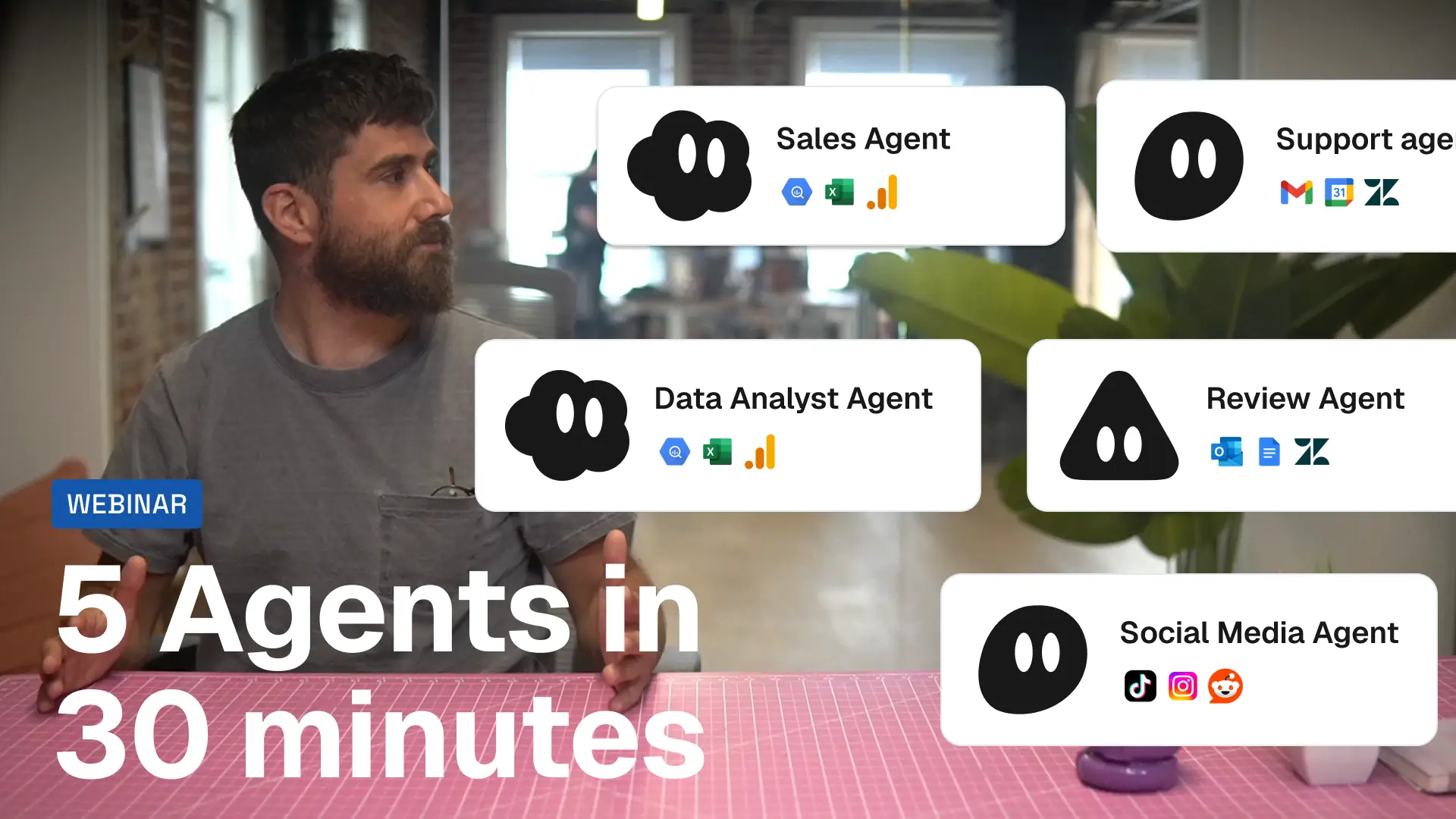
Watch the original workshop: 5 Agents in 30 Minutes on Vimeo
Building an AI agent is getting easier. Building one that deserves access to company data is another matter. A 30-minute workshop can demonstrate five prototypes, but reliable business automation still requires testing, permissions and oversight.
Agents vs Flows: The Distinction That Matters
Traditional flows execute predefined steps. Agents interpret context and choose between permitted tools or actions. That flexibility helps with ambiguous requests but introduces uncertainty. A strong system often combines the two: let the agent interpret the request and a deterministic flow validate consequential actions.
1. Sales Collateral Agent
This agent assembles customer-specific product briefs, comparison material and follow-up drafts from approved documentation. Its value lies in cutting repetitive drafting, not in inventing new sales claims. Pricing, testimonials and integration promises must come from verified sources. A human should approve outbound collateral.
2. Sales Preparation Agent
Before a meeting, the agent can retrieve CRM history, identify unresolved objections, summarize recent account activity and propose discovery questions. The best briefing prioritizes two or three decisive facts rather than producing a long generic report. Separate verified account history from AI-generated recommendations.
3. Support Escalation Agent
Support tickets vary in urgency. An agent can examine customer impact, service agreements, incident history and escalation policies to suggest priority and routing. An angry message is not necessarily critical; a politely worded outage report may be. High-severity incidents need deterministic triggers, a human fallback and monitoring.
4. Project Management Agent
A project agent can consolidate task updates, flag overdue dependencies and draft a weekly status review. But an “In Progress” status is not proof of actual progress. Reliable summaries must account for milestones, blockers and evidence of delivery. Proposed task changes should be reviewed before being written back.
5. Data Analyst Agent
A natural-language analyst can translate questions into authorized database queries and explain the results. The central risk is semantic: “revenue” may mean gross sales, net sales or recognized revenue. The agent should disclose metric definitions, time periods and filters, provide reproducible calculations and use read-only access wherever practical.
Which One Should You Build First?
For many organizations, Sales Preparation is the sensible first prototype: clear purpose, reviewable output and little need to modify critical records. Sales Collateral is also approachable with an approved knowledge base. Support Escalation needs robust safeguards; Project Management depends on clean task data; Data Analyst has substantial potential but requires rigorous metric validation.
Can You Really Build Five Agents in 30 Minutes?
A guided demonstration with prepared integrations and sample data may produce five prototypes in half an hour. That is not the same as five production-ready systems. Permissions, edge-case evaluation, integration failures, auditability and ongoing costs remain. The real business metric is dependable time saved, not the number of agents created.
Belliste Verdict
Agents should not replace every workflow. Use them where interpretation and context matter; use predictable automation for controlled execution. The most credible implementation is not an unrestricted digital employee but a bounded assistant whose output can be checked.
Frequently Asked Questions
What is the difference between an AI agent and an automation flow?
A flow follows predefined steps; an agent can interpret context and choose among permitted actions. They often work best together.
Can beginners build AI agents without coding?
Visual builders simplify prototyping, but production integrations, security and testing may still require technical expertise.
Which agent should a beginner build first?
A Sales Preparation Agent is a practical first project because its briefings are easy to review before use.
Can AI agents manage customer support?
They can assist with triage and summarization, while high-impact escalation should remain subject to explicit rules and oversight.
Can an AI data analyst replace a human analyst?
It can accelerate routine queries, but people remain essential for defining metrics, validating results and interpreting business implications.
Watch the Original Workshop
Watch “5 agents in 30 minutes” on Vimeo
The linked workshop covers agents versus flows and examples in sales collateral, sales preparation, support escalation, project management and data analysis. This article is an independent editorial guide, not a verified step-by-step transcript of the video.