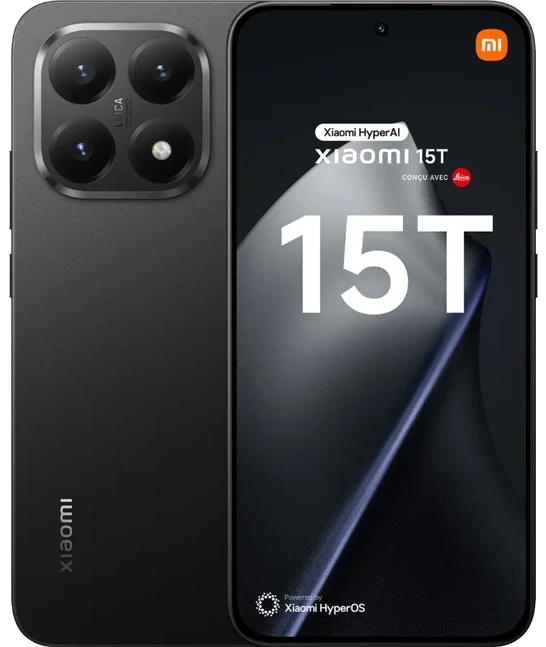
The Xiaomi 15T has the speed for demanding games, but its everyday compromises tell the more useful story. In the supplied hands-on review, Wuthering Waves pushes the surface temperature to 41°C, copying a 1.74GB file from external storage takes about three minutes, and the reviewer still finishes ordinary days with battery remaining. It is a capable phone, though not every part of the experience is equally fast.
This analysis draws on the linked hands-on video; Belliste did not independently test the device. Temperatures and battery estimates are the reviewer's observations.
Design: Solid Construction Without a Metal Frame
The reviewed black Xiaomi 15T has a fiberglass-style back and plastic sides. The reviewer finds it solid, with no creaking when he squeezes the body, although it lacks the metallic feel of more expensive flagships. The camera island creates a noticeable wobble when the phone rests on a desk.
The 6.83-inch screen has slim borders, with a slightly thicker lower bezel. Physical controls have firm feedback. An infrared blaster can control compatible TVs and air conditioners, and the phone offers NFC, IP68 protection and an X-axis vibration motor. The reviewer calls the haptics consistent but short of flagship quality.
His unboxing shows a protective case, USB-A-to-USB-C cable, SIM ejector and paperwork. Box contents can differ by market, so buyers should check their regional package.
Display: Excellent HDR, but a Lower Refresh Rate Than the 14T
The 6.83-inch AMOLED panel has a 1.5K-class resolution, approximately 447 pixels per inch and a 120Hz refresh rate. The reviewer highlights Dolby Vision, HDR10+ and DCI-P3 support, alongside Gorilla Glass 7i protection.
In the reviewer's footage, HDR images show deep blacks and vivid colors. He notices a slight color-temperature shift at extreme viewing angles. Xiaomi's 3,200-nit peak claim is not independently measured in this video.
Refresh-rate settings offer adaptive behavior or a manual choice of 60Hz and 120Hz, with an app list for high-refresh operation. This is a numerical step down from the Xiaomi 14T's advertised 144Hz, though the video does not establish a meaningful everyday smoothness difference between the two.
The reviewer also finds an irritating limitation: the always-on display option shown on his unit lights up for only ten seconds after a tap, rather than staying visible indefinitely. Its availability and behavior may depend on software settings or region.
Streaming, Touch Response and Speakers
YouTube HDR playback and Widevine L1 support for Full HD Netflix are demonstrated or reported in the review. Motion interpolation is less convincing: the reviewer notices an artificial, soap-opera effect.
Xiaomi advertises 480Hz touch sampling and a higher instantaneous sampling mode through Game Turbo. Those specifications describe input polling behavior, not the screen's visible refresh rate.
Stereo audio comes from a bottom speaker and the earpiece. In the reviewer's comparison, the Xiaomi 15T sounds louder than an iPhone 15 Pro Max, but the iPhone delivers deeper bass. His assessment is of clear, powerful speakers rather than class-leading low-frequency sound. Dolby Atmos and Xiaomi sound presets offer additional tuning.
Dimensity 8400 Ultra: Fast Apps, One Slow Connection
The Xiaomi 15T uses MediaTek's Dimensity 8400 Ultra. The reviewed configuration has 12GB of LPDDR5X RAM and UFS 4.1 storage, with 256GB and 512GB options described in the video.
Apps open quickly, browsing and messaging are smooth, and the reviewer uses floating windows and split-screen multitasking without significant stutter. His AnTuTu run produces roughly 1.8 million points. That is one benchmark result from his setup, not a universal score across software versions and test temperatures.
A less flattering test involves external storage through the USB-C 2.0 port. Scrubbing through 4K video directly from a connected drive introduces lag, while copying a 1.74GB file into internal storage takes approximately three minutes. That bottleneck matters to anyone who frequently moves large video files between the phone and an external drive.
Video editing is more encouraging. The reviewer imports a four-minute, 36-second 4K clip into CapCut, edits using a 1080p preview and exports at 4K in about one minute and 20 seconds. This is a useful demonstration of the phone's processing ability, though export time depends on the footage, effects and encoder settings.
Gaming: 41°C in Wuthering Waves
The reviewer runs roughly 90 minutes of games in performance mode, starting at 77% battery and a surface temperature near 28°C.
Warzone Mobile stays smooth through about 30 minutes, with a peak surface reading near 38°C. Roblox also runs smoothly.
Wuthering Waves puts the phone under heavier pressure. With graphics settings pushed high, the reviewer notices occasional frame drops and measures a peak surface temperature around 41°C after half an hour. He considers the heat manageable for such a demanding game, although the phone feels noticeably warm.
Call of Duty: Mobile supports a 120fps setting in his demonstration, with responsive gameplay. The built-in Game Turbo frame-rate overlay sometimes reports implausible numbers, including figures above a game's selected 60fps cap. Its readings should not be mistaken for validated frame-time measurements.
After 90 minutes, battery charge falls from 77% to 43%, a 34-percentage-point loss. The final surface reading is about 35°C. Gaming is generally smooth, but Wuthering Waves shows that heat and occasional frame drops remain part of the experience.
Cameras: A Useful 50MP Main and 2x Telephoto
The rear camera array combines a 50MP main camera, 50MP telephoto and 12MP ultrawide, with Leica-branded imaging modes. A 32MP camera handles selfies.
The reviewer's outdoor stills leave a positive impression, and he shows Leica Authentic and Leica Vibrant options that change the image rendering. The telephoto offers a 2x optical view, while the camera app permits much higher digital zoom levels. Digital enlargement, particularly the extreme 70x setting shown for photographs, is not equivalent to optical reach or guaranteed detail.
The reviewer presents real-world sample footage rather than a controlled comparison of color accuracy, dynamic range or nighttime noise. His favorable reaction supports the conclusion that the camera is enjoyable to use, but it does not establish that the Xiaomi beats similarly priced rivals in every condition.
Built-in editing includes familiar adjustments alongside AI erasing and generative image expansion. Expanded image areas are generated content, not additional scene detail captured by the sensor.
Video Recording: Good Stabilization, Lens-Switching Restrictions
The rear camera records up to 4K at 60fps in the demonstrated modes, while ultrawide video is limited to 30fps. The front camera reaches 4K at 30fps. The camera settings include H.264 and HEVC encoding options and an HDR10+ toggle.
The reviewer records handheld clips outdoors, in town and in a field. He is pleased with the stabilization and general video appearance. There is a practical limitation, however: during some 4K 60fps recording sequences he cannot switch directly to the telephoto camera after recording begins. Instead, the zoom available in that mode behaves digitally. Users who frequently change focal lengths mid-clip should test their preferred resolution and frame-rate combination before relying on it.
The samples also show front-facing video and lower-light walking footage, but the video does not provide a laboratory comparison of exposure stability or noise. Belliste therefore does not assign a measured camera-quality ranking from these examples.
Battery Life: Dependable Days, Without a Timed Charging Test
The 5,500mAh battery supports 67W wired HyperCharge. The reviewer reports getting through days of camera use, streaming, social media and gaming with approximately 10–20% remaining by evening. With lighter use, he says the phone can stretch toward a day and a half.
Those are personal usage observations, not a standardized Active Use Score. The review does not time a full charging cycle, so it would be misleading to attach a precise zero-to-100% charging duration to this video.
The 67W rating is lower than the Xiaomi 15T Pro's 90W specification. The practical difference will depend on charger compatibility and charging conditions, not just the advertised wattage.
Xiaomi 15T vs Xiaomi 15T Pro
The standard 15T is not simply a smaller version of the Pro: both use a large 6.83-inch screen, but their hardware priorities differ. The 15T has the Dimensity 8400 Ultra, a 120Hz panel, 2x telephoto and 67W charging. The Pro steps up to a Dimensity 9400+, 144Hz-rated display, 5x telephoto and 90W wired charging.
That makes the choice clearer than the names suggest. Buyers who mainly browse, stream, edit occasional clips and take portraits may find the standard 15T sufficient. The Pro is the more relevant option for longer-distance optical photography and higher peak processing performance. Actual value depends on the price gap where you shop.
Verdict: A Fast Daily Phone With Specific Limits
The Xiaomi 15T makes a convincing case for buyers who want a large AMOLED display, responsive everyday performance and reliable battery life without paying for the Pro model.
Its Dimensity 8400 Ultra handles demanding games well, although the reviewer's Wuthering Waves session pushed surface temperatures to 41°C. The cameras offer useful flexibility, but restrictions on switching lenses during certain 4K recording modes may frustrate frequent video shooters.
The decision comes down to price and priorities. Choose the Xiaomi 15T for everyday speed, media consumption and occasional gaming. The 15T Pro becomes more attractive if its stronger processor and 5x telephoto justify the extra cost.